
SEO for Bloggers: A Practical, Step-by-Step Guide to Grow Organic Traffic
Every blogger who wants steady, sustainable growth needs a plan for SEO that goes beyond guessing keywords or publishing whenever inspiration strikes. This guide walks through what matters most — from research and on-page tweaks to technical foundations and promotion — with practical examples and an actionable workflow a content creator can follow week after week.
Why SEO matters for bloggers
Organic search remains one of the most cost-effective ways to attract readers. A single well-optimised post can generate traffic for months or years, building cumulative value and lowering customer acquisition costs. For a small business owner, digital marketer, or content creator, mastering seo for bloggers turns content from a time sink into a marketing asset.
Bloggers who understand SEO benefit in three main ways:
Discoverability — readers find posts through search queries rather than relying solely on social shares.
Authority — consistent, helpful content builds topical authority, which boosts rankings over time.
Predictability — a repeatable SEO workflow leads to predictable traffic growth and reliable ROI.
Core SEO concepts every blogger must grasp
Keywords and search intent
Keywords are more than words — they represent what the searcher wants. A blogger must match content to intent. There are three broad intent types:
Informational — the user wants to learn (e.g. "how to start a vegetable garden").
Transactional — the user intends to buy or take action (e.g. "best vegan protein powder").
Navigational — the user seeks a specific site or page (e.g. "BBC weather").
For most blogs, prioritising informational queries and long-tail keywords will pay off. Long-tail phrases are less competitive and often have clearer intent. Use SERP analysis: look at the current top-ranking pages and the types of content Google is rewarding, then mirror that format while adding something unique.
On-page SEO
On-page SEO ensures search engines understand what a page is about and signals value to users. Key elements include:
Title tag — keep it descriptive, include the target keyword near the front, and aim for 50–60 characters.
Meta description — write a concise summary (120–160 characters) that improves click-through rate.
Headings (H1, H2, H3…) — use headings to structure the content and include related phrases naturally.
URL — make it short and include the main keyword (avoid dates or excessive parameters).
Image optimisation — compress images, use descriptive filenames, and add alt text that describes the image and supports the page topic.
Internal links — link to relevant posts on the blog to pass authority and help users discover more content.
Example title and meta:
<title>SEO for Bloggers: How to Rank Faster and Get More Traffic</title>
<meta name="description" content="Practical SEO for bloggers: keyword research, on-page optimisation, technical tips and a workflow to boost organic traffic." />
Technical SEO
Technical SEO covers site performance and crawlability. A few priorities for bloggers:
Mobile-first — ensure the site is responsive and content is legible on small screens.
Page speed — compress images, enable caching, and use a fast hosting provider.
Sitemap and robots.txt — submit an XML sitemap to Google Search Console and ensure robots.txt doesn’t block important pages.
Structured data — add schema to help search engines display rich results (e.g. article schema for posts).
HTTPS — secure the site with an SSL certificate.
Simple JSON-LD for an article:
{
  "@context": "https://schema.org",
  "@type": "Article",
  "headline": "SEO for Bloggers: How to Rank Faster and Get More Traffic",
  "author": {
    "@type": "Person",
    "name": "Jane Doe"
  },
  "datePublished": "2024-08-01",
  "image": "https://example.com/images/seo-for-bloggers.jpg"
}
Content quality and E‑A‑T
E‑A‑T stands for Expertise, Authoritativeness, and Trustworthiness. Google assesses these signals, especially for topics that affect people's finances, health, or safety.
Bloggers can improve E‑A‑T by:
Publishing accurate, well-researched content with cited sources.
Maintaining an author bio that highlights relevant credentials or experience.
Keeping content up to date and correcting errors promptly.
Practical workflow: SEO for bloggers (step-by-step)
The following workflow is designed for a small team or solo blogger. It’s repeatable and focuses on output quality over quantity.
1. Topic selection and keyword research
Start with a list of topics that align with the blog’s niche and audience needs. Then validate demand with keyword tools (Google Keyword Planner, Ahrefs, SEMrush, or free tools like AnswerThePublic).
Process:
Brainstorm 20 seed topics related to the core niche.
For each seed topic, find 10 long-tail queries people ask.
Check search volume and competition. Prioritise low-to-medium competition with clear intent.
Run a SERP analysis — what format ranks? How long are the top posts? What questions do they answer?
2. Create a detailed outline
A solid outline saves time when writing. Include target headings, recommended word counts for each section, sources to cite, and a proposed meta description.
Example outline for "how to start a vegetable garden":
H1: How to Start a Vegetable Garden (keyword: start a vegetable garden)
Intro: Quick promise + who it’s for
H2: Choosing a site and soil
H2: Planning what to plant (with calendar)
H2: Planting, watering and maintenance
H2: Common problems and solutions
H2: Resources and tools
Conclusion + CTA
3. Write with the reader and search engines in mind
Write clearly and use short paragraphs. Use the outline to keep focus and include the target keyword and closely related terms naturally in headings and body text. Add examples, images, and step-by-step instructions to increase time on page and user satisfaction.
4. Optimise before publishing
Use an on-page checklist:
Primary keyword in title, first paragraph, at least one H2, and natural occurrences elsewhere.
Meta description contains the keyword and a compelling reason to click.
Images compressed and have descriptive alt text.
Structured data added if relevant.
Internal links to related posts (3–5 links) and an external citation to an authoritative source.
5. Publish and submit
Publish at a time when the audience is active if known. Then:
Submit the URL to Google Search Console for faster indexing.
Share to relevant social channels and email lists.
Post in communities where the content adds value (without spamming).
6. Promote and build links
Promotion amplifies the post. Link-building tactics that work for bloggers include:
Guest posts on niche sites
Reaching out to journalists or bloggers who link to similar content
Creating sharable assets (cheat sheets, infographics)
Repurposing content into short videos or newsletters
7. Measure and iterate
Set KPIs and check them regularly. Use Search Console and analytics tools to monitor impressions, clicks, click-through rate (CTR), average position, and conversions. If a post underperforms, try updating the title, adding fresh content, or improving on-page elements.
Content formats that win in search
Different formats satisfy different intents. A blogger should experiment with a few proven formats:
How-to guides — step-by-step instructions often rank for "how to" queries.
Listicles — easy to scan and often attract links.
Case studies — demonstrate results and build credibility.
Comparisons and reviews — useful for purchase-intent queries.
Resource pages & roundups — attract links as a hub of useful tools or references.
FAQs — answer specific questions and target featured snippets.
Pillar pages and topic clusters work particularly well. A pillar page covers a broad topic and links to detailed cluster posts, signalling topical depth to search engines.
Advanced tactics for bloggers
Targeting featured snippets
Featured snippets appear above regular results for question queries. They favour concise, well-structured answers. To target them:
Answer the question within the first 100–200 words.
Use short paragraphs, bullet lists, or numbered steps.
Structure content clearly with relevant headings.
Internal linking strategy
Think of internal links as pathways that distribute page authority. Use a hub-and-spoke model: the pillar page (hub) links to cluster pages (spokes) and vice versa. Vary anchor text naturally and don’t over-optimise with exact-match anchors.
Content pruning and refreshes
Old posts can drag down a site if they’re irrelevant or low quality. Periodically:
Update facts and examples
Consolidate thin posts into comprehensive guides
Remove or redirect pages that add no value
Leveraging user signals
Search engines may consider engagement metrics such as dwell time and CTR. Improve these by crafting compelling introductions, adding multimedia, and formatting content for easy scanning.
SEO for voice search and AI chatbots
With assistant platforms and AI chatbots becoming common, bloggers should optimise for conversational queries. Tactics include:
Answering common questions succinctly near the top of the post.
Using natural language and long-tail question phrases.
Providing structured summaries that voice assistants can read aloud.
Structured data and clear, concise content increase the chances that an AI will use a blogger’s content as a source when answering user queries. For more on AI and search, see Using AI for SEO.
Measuring success and iterating
Tracking the right metrics helps a blogger make informed decisions. Focus on:
Organic traffic — sessions from search engines.
Impressions and clicks in Google Search Console.
Keyword rankings — track a selection of core and long-tail keywords.
Engagement metrics — time on page, pages per session, bounce rate (consider context).
Conversions — newsletter sign-ups, product purchases, enquiries.
Use a monthly review process: identify top-performing content, find posts that are losing traffic, and prioritise updates that can move the needle.
How automation helps: a word on Casper
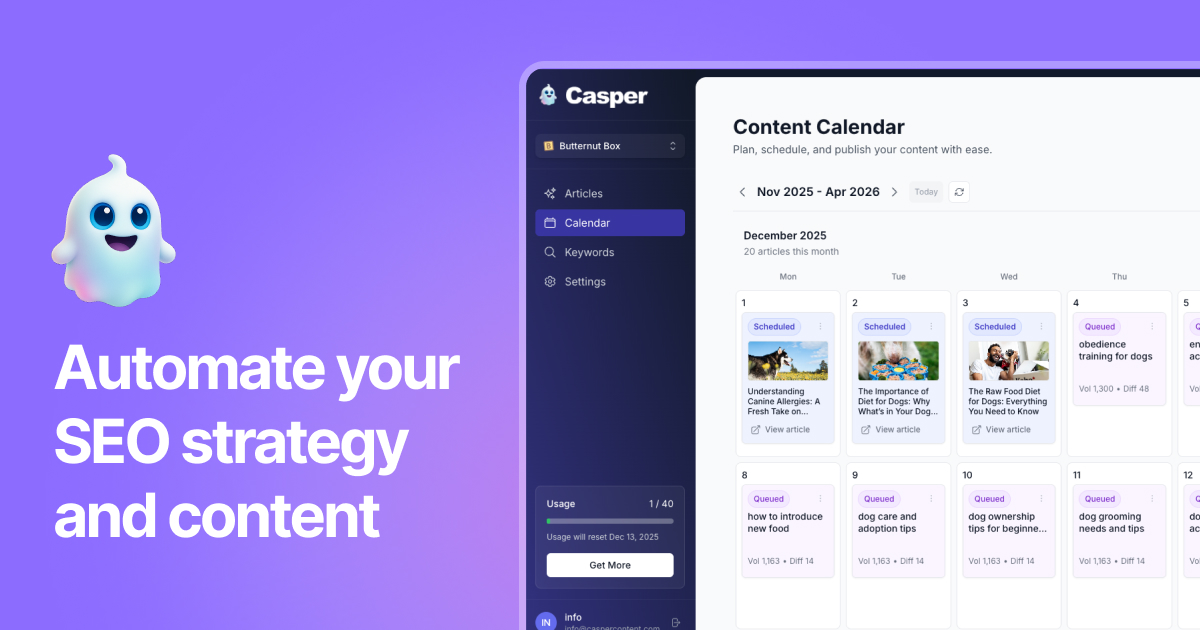
Many bloggers juggle content creation with other responsibilities. Automation can reduce repetitive work. For example, Casper offers a platform that automatically researches, writes, and publishes SEO-optimised articles. For a small business owner or content creator, this kind of tool speeds up the entire process — from keyword research and outline generation to on-page optimisation and publishing — while allowing the blogger to retain control over edits and brand voice.
Important considerations when using automated content generation:
Always review and fact-check output — automated systems can make mistakes or miss context.
Customise tone and examples to maintain authenticity and connection with readers.
Use automation to scale research and drafts, but add human edits for authority and nuance.
When used thoughtfully, automation is a force multiplier: it enables consistent publishing cadence, improves SEO workflow efficiency, and frees time for strategy, outreach, and creative work. If you want a deeper look at automating parts of the SEO process, check out Automating SEO in 2025.
Checklist: Post-publish optimisation for bloggers
Use this quick checklist after publishing:
Submit to Google Search Console for indexing.
Share the post on social channels and in an email newsletter.
Link from at least two relevant posts on the blog.
Monitor impressions and clicks in Search Console after one week.
Plan a content refresh schedule for evergreen posts (every 6–12 months).
Common mistakes to avoid
Chasing every keyword — focus on topics that match audience needs rather than vanity keywords.
Neglecting user experience — poor layout, intrusive ads, or slow pages repel readers and harm rankings.
Publishing thin content — short posts with no value rarely rank or convert.
Over-optimising anchor text — unnatural internal linking can look manipulative.
Ignoring analytics — publishing without measurement prevents growth and improvement.
Real-world example: a content cluster that worked
A boutique coffee roaster ran a blog to attract retail customers. Instead of random posts, the team built a cluster around "home coffee brewing":
Pillar page: The ultimate guide to brewing coffee at home
Cluster posts: How to grind coffee beans, French press guide, how to brew pour-over, equipment reviews, common mistakes
By internally linking the cluster and producing one comprehensive pillar page, the roaster saw a 3x increase in organic traffic to brew-related pages within six months. The pillar page ranked for dozens of long-tail queries and brought consistent conversions to the online shop.
Conclusion
SEO for bloggers is a mix of craft and process. It requires understanding search intent, producing high-quality content, nailing the technical basics, and iterating with data. For busy creators, automation platforms can help scale production while a human touch preserves credibility and brand voice. By following a repeatable workflow — research, outline, write, optimise, publish, promote, measure — bloggers turn one-off posts into long-term traffic drivers.
Consistency and user-first thinking win. A blogger who publishes useful, well-structured content, maintains the site’s technical health, and continually refines strategy based on real metrics will see steady gains. Start with one focused cluster, measure results, and then scale. With the right balance of effort and smart automation, organic growth becomes far more achievable.
Frequently Asked Questions
How long does it take to see results from SEO for bloggers?
SEO timelines vary by niche and competition. Small improvements (indexing and initial traffic) can appear in a few weeks, but meaningful, stable gains often take 3–6 months. Evergreen content and consistent publishing typically show the best long-term results.
How long should a blog post be to rank well?
There’s no fixed length that guarantees ranking. Instead, focus on covering the topic comprehensively. In many niches, long-form posts (1,500–3,000+ words) that answer multiple related questions perform well, but concise, high-quality answers can still rank for specific queries or featured snippets.
Can automation replace human writers for SEO content?
Automation can speed research and drafting, and tools like Casper produce SEO-optimised posts quickly. However, human oversight remains essential for accuracy, creativity, tone, and strategic decisions. The best approach blends automation for efficiency with human editing for quality.
What are the best tools for keyword research for bloggers?
Popular tools include Ahrefs, SEMrush, Moz, and Google Keyword Planner. Free options like Google Search Console and AnswerThePublic are useful too. For bloggers on a budget, combining Search Console insights with keyword suggestion tools and SERP analysis works well.
How often should bloggers update old posts?
Review evergreen posts every 6–12 months. Update facts, images, and internal links, and consider expanding sections based on user queries. For high-traffic posts, even quarterly checks can be worthwhile.
Casper Team
The Casper Team is dedicated to providing the best AI content generation tools and insights to help you succeed in content marketing.