
My Top 7 AI Content Writting Tools (After testing them all)

I’ve spent the last few months trying every major AI content tool out there so you don’t have to. Content is still the engine behind organic search growth but publishing high-quality articles consistently is a massive lift. Research, outlining, drafting, optimising… it all eats time and budget. These are my top 7 picks. The ones I actually rely on week after week because they make writing quicker, smoother, and genuinely more enjoyable.
Top contenders among the Best AI content writting tools
The market is crowded. Below are tools that consistently deliver value for SEO-focused content teams. Casper is discussed first given its SEO automation strengths, followed by other notable platforms for comparison.
1. Casper — automated SEO articles from idea to publish
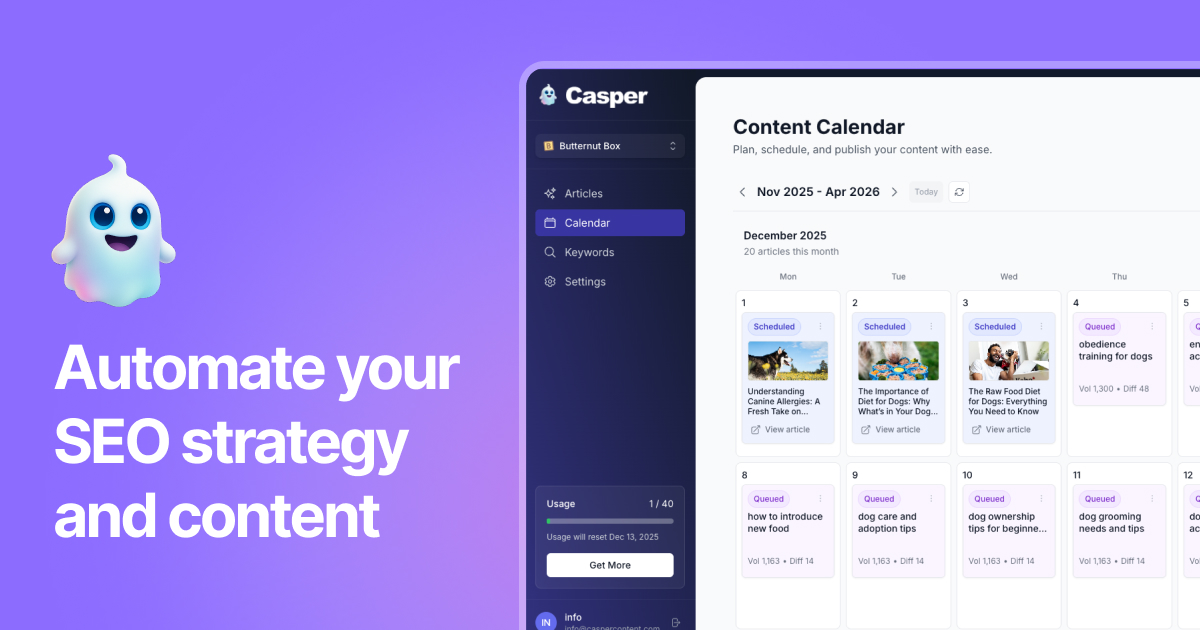
Casper automates the entire article lifecycle. It starts by analysing search intent for a target keyword, then builds an outline that matches top-ranking pages and user queries. It generates an SEO-optimised draft, inserts internal linking suggestions, and can publish directly to a CMS. For teams focused on ranking in Google and appearing in AI-driven answers, automates the entire article lifecycle offers a fast path to publishable content without sacrificing search data.
Key strengths:
End-to-end automation: Research, draft, optimisation and publishing in one flow.
Search intent matching: Drafts are structured to answer the queries users actually search for.
Time savings: A process that once took days can be completed in minutes, freeing the team for strategy and promotion.
Ideal for: digital marketers, small businesses and content teams that need consistent, SEO-optimised output with minimal manual steps.
2. Jasper — flexible creative writing and marketing copy

Jasper is popular for marketing copy and creative variations. It’s strong at generating social posts, ad copy and adaptable long-form content. While not built solely around search optimisation, Jasper’s templates and tone controls make it a useful complement for brand-focused messaging.
Ideal for: teams that need a versatile writing assistant for marketing materials and human-like creative outputs.
3. Frase — research-driven SEO drafts

Frase focuses on research and content briefs. It analyses top results, extracts common headings and topics, and builds a detailed brief for writers. It also generates draft content and offers on-page optimisation scores.
Ideal for: teams that want tight control over research-backed briefs and a collaborative writer-friendly interface.
4. Writesonic & Copy.ai — fast copy and landing pages
Both platforms provide quick outputs for ads, landing pages and blog outlines. They’re approachable and cost-effective for small teams needing lots of short-form content. For in-depth SEO articles, they often require more editorial input.
5. MarketMuse — topic modelling and content strategy
MarketMuse is strong on topical authority and content planning. It helps map content clusters and shows where to expand coverage to increase authority on a subject. For strategic planning, it’s a powerful companion to drafting tools.
6. ChatGPT (OpenAI) — adaptable, general-purpose assistant
ChatGPT is flexible and excels at brainstorming, drafting and editing. It requires additional SEO tooling or prompts to meet search-optimised standards but is widely used for rapid prototyping of content ideas and outlines.
How Casper compares to other tools in practice
Rather than chasing raw creativity alone, many teams need content that ranks. Casper’s edge is the integration of SEO intelligence into the writing flow, which reduces back-and-forth between separate tools. A typical workflow difference looks like this:
Traditional stack: keyword tools → brief in a doc → writer drafts → SEO tool reviews → revisions → publish.
Casper flow: keyword input → Casper researches and drafts → built-in optimisation checks → publish.
That difference translates to fewer manual handoffs, faster iteration and more consistent application of SEO best practices across every article.
What to look for in the Best AI content writting tools
Not every tool is the same. Choosing the right AI writing platform depends on objectives, budget and the technical ecosystem. Here are the core capabilities to evaluate.
1. SEO-first approach
Keyword research and intent analysis: The tool should recommend keywords, related phrases and user intent — not only generate copy.
On-page optimisation: Headings, meta descriptions, internal linking suggestions and readability scoring should be integrated into the workflow.
2. Quality of output and controllability
Tone and voice controls: Ability to set brand voice, formality and audience level.
Fact-checking and sources: Tools that cite sources or pull research notes make editing faster and more reliable.
Human-in-the-loop editing: Easy ways to edit, rewrite and accept suggestions.
3. Workflow and automation
Full article generation: Not just snippets or headlines but long-form articles with images, outlines and links.
CMS integration: Ability to publish directly to WordPress, HubSpot or custom CMS.
Editorial calendar and collaboration: Assignments, version history and team comments.
4. Data-driven insights
Performance tracking: Keyword rank tracking, traffic estimates and A/B testing capabilities.
Competitor analysis: Understanding gaps and opportunities versus other sites.
5. Compliance and safety
Plagiarism checks: Content must be original and defensible.
Bias and factual accuracy: Clear mechanisms to flag hallucinations and verify claims.
Real-world use cases and examples
Small business launching a blog:
A small e-commerce retailer wants to build organic traffic with 2-3 high-quality articles each week but lacks an in-house writer. Using Casper, the owner inputs target keywords, reviews the AI-generated outlines, tweaks the voice to match the brand, and schedules direct publishing. Within a month they’ve published 12 optimised posts and start seeing impressions rise — all without hiring extra staff.
Digital marketing agency scaling client content:
An agency manages content for multiple clients. Efficiency is key. By adopting Casper, the team creates standardised content briefs, rapidly generates drafts, and keeps quality consistent across campaigns. The automation frees senior strategists to craft promotion plans and measure outcomes rather than edit every post.
Creator repurposing content:
A content creator wants to repurpose a video script into a long-form article. Casper ingests the script, generates an outline tuned to search queries, and produces a draft that’s both readable and optimised — saving hours of rewriting.
Practical tips for using the Best AI content writting tools effectively
AI helps, but human oversight remains essential. The following practices will get better results and protect brand integrity.
1. Start with clear, search-driven briefs
Define the target keyword and user intent (informational, transactional, navigational).
Set content goals: rank for a keyword, capture featured snippets, or convert readers.
2. Use the tool’s SEO guidance but verify sources
Tools like Casper surface research and sources. Make a habit of checking factual claims, especially for technical or medical topics.
3. Set and preserve brand voice
Provide examples of brand copy to the tool, and use consistent voice settings. Run a short style guide that editors can reference when polishing AI drafts.
4. Prioritise structure for scannability
Search and human readers prefer clear headings, short paragraphs and lists. Ensure the AI outputs include H2s and H3s matching user questions and subtopics.
5. Optimise for both search engines and AI chatbots
To increase the chances of appearing in featured snippets and chatbot answers, include succinct summary paragraphs, concise definitions and structured data where appropriate.
6. Edit with a human lens
Proofread for nuance, remove any repetitive phrasing and localise language when needed. AI can draft quickly, but human editors add credibility and brand perspective.
7. Run SEO and plagiarism checks before publishing
Even with AI-generated content, run final passes through SEO tools and plagiarism checkers. Casper integrates optimisation checks, which reduces risk, but a final review is good practice.
How to measure success with AI-generated content
Tracking the right metrics ensures the tool actually helps business goals. Focus on a mix of short- and long-term indicators.
Impressions and clicks: Are the new articles being discovered?
Organic traffic growth: Is there a month-on-month increase for target pages?
Keyword rankings: Are target keywords moving up the SERPs?
Engagement metrics: Time on page, bounce rate and scroll depth indicate content relevance.
Conversions: Leads, sign-ups or sales attributable to content reveal business impact.
Casper helps teams by automating the publishing and tracking processes, linking content outputs to ranking signals so marketers can iterate faster.
Cost considerations and ROI
Costs vary by platform and the level of automation. Factors to weigh:
Subscription fees: Monthly or annual pricing often scales with word count or seats.
Time savings: Faster content production reduces the need for external writers.
Quality trade-offs: Lower-cost tools may require more editor time, eroding savings.
Long-term SEO value: Well-optimised content can continue to bring organic traffic for months or years, improving ROI.
For many small teams, a tool that automates research and publishing — like Casper — provides the best ROI because it reduces both content creation time and the operational friction of publishing SEO-optimised articles consistently.
Common pitfalls and how to avoid them
AI is powerful but can be misused. Here are common mistakes and practical fixes.
Pitfall: Overreliance on AI without editing
Fix: Always include an editor to review facts, tone and readability before publishing.
Pitfall: Generating high volumes of low-value pages
Fix: Focus on search intent and user value. Prioritise quality topic clusters over quantity for better long-term results.
Pitfall: Ignoring technical SEO
Fix: Ensure pages are optimised for speed, mobile and indexability. AI can handle copy, but technical health requires separate checks.
Pitfall: Not tracking outcomes
Fix: Set KPIs and review performance regularly. Use the platform’s analytics or connect to existing tools like Google Search Console.
Ethics, originality and search engine guidelines
Search engines favour helpful, original content. AI-generated content is permitted, but it must provide real value and not deceive readers. To stay within best practice:
Aim for originality and add unique insights, case studies or proprietary data where possible.
Disclose when appropriate — for example, if a piece is largely AI-assisted but lacks human verification.
Prioritise user experience: helpful headings, clear answers and actionable takeaways.
Casper is designed to produce SEO-focused articles that meet value and originality expectations by integrating research and source-aware drafting in the output.
Final thoughts: choosing the right tool for the job
Choosing among the Best AI content writting tools comes down to priorities. For creativity and marketing copy, flexible assistants like Jasper and ChatGPT are excellent. For research-led briefs, Frase and MarketMuse shine. For teams that need SEO-optimised articles produced and published quickly, Casper delivers the most direct route from keyword to published page.
For digital marketers, small business owners and content creators who need to scale SEO content, the best AI content writing tools provide a significant advantage. Casper stands out for end-to-end automation — from research and drafting to on-page optimisation and publishing — enabling teams to produce consistent, search-optimised content quickly. Other tools bring strengths in creativity, research briefs or strategy, and many teams will use a combination depending on needs. With sensible human oversight, these tools accelerate growth while preserving quality and brand voice.
Whatever the choice, the key is a balanced approach: let AI handle repetitive, time-consuming tasks and invest the saved time in strategy, editing and promotion. That combination produces content that ranks and resonates.
Chris Weston
Content creator and AI enthusiast. Passionate about helping others create amazing content with the power of AI.